Chapter 22 Section 1 Guided Reading and Review Historical Political Systems
14.2 Types of Political Systems
Learning Objectives
- Discuss the advantages and disadvantages of representative commonwealth.
- Explain why authoritarian and totalitarian regimes are more unstable politically than democracies and monarchies.
Diverse states and governments obviously exist effectually the globe. In this context, land means the political unit within which ability and authorisation reside. This unit of measurement tin be a whole nation or a subdivision inside a nation. Thus the nations of the earth are sometimes referred to as states (or nation-states), every bit are subdivisions within a nation, such as California, New York, and Texas in the Us. Government means the grouping of persons who direct the political affairs of a state, merely it tin besides hateful the blazon of rule by which a land is run. Some other term for this second meaning of government is political organisation, which we will use here along with government. The type of government nether which people live has key implications for their freedom, their welfare, and even their lives. Accordingly we briefly review the major political systems in the world today.
Democracy
The type of government with which we are most familiar is democracy, or a political system in which citizens govern themselves either directly or indirectly. The term democracy comes from Greek and means "dominion of the people." In Lincoln'southward stirring words from the Gettysburg Address, democracy is "government of the people, by the people, for the people." In direct (or pure) democracies, people make their own decisions well-nigh the policies and distribution of resources that bear on them directly. An example of such a democracy in action is the New England town meeting, where the residents of a town meet one time a year and vote on budgetary and other matters. However, such directly democracies are impractical when the number of people gets beyond a few hundred. Representative democracies are thus much more common. In these types of democracies, people elect officials to represent them in legislative votes on matters affecting the population.
Representative democracy is more than practical than direct democracy in a social club of any meaning size, but political scientists cite another advantage of representative republic. At least in theory, it ensures that the individuals who govern a order and in other means help a guild function are the individuals who have the advisable talents, skills, and knowledge to practise so. In this style of thinking, the masses of people are, overall, too uninformed, also uneducated, and as well uninterested to run a society themselves. Representative democracy thus allows for "the cream to rise to the top" and so that the people who actually govern a society are the most qualified to perform this essential task (Seward, 2010). Although this statement has much merit, it is likewise true that many of the individuals who exercise get elected to office turn out to be ineffective and/or corrupt. Regardless of our political orientations, Americans can retrieve of many politicians to whom these labels apply, from presidents down to local officials. Equally we hash out in Chapter xiv "Politics and Government", Department fourteen.4 "Politics in the U.s.a." in relation to political lobbying, elected officials may also be disproportionately influenced by campaign contributions from corporations and other special-interest groups. To the extent this influence occurs, representative commonwealth falls short of the ideals proclaimed past political theorists.
The defining feature of representative republic is voting in elections. When the United States was established more than 230 years ago, near of the world's governments were monarchies or other authoritarian regimes (discussed shortly). Like the colonists, people in these nations chafed under arbitrary power. The example of the American Revolution and the stirring words of its Declaration of Independence helped inspire the French Revolution of 1789 and other revolutions since, as people around the earth have died in order to win the right to vote and to have political liberty.
Democracies are certainly not perfect. Their controlling process can be quite slow and inefficient; equally just mentioned, decisions may be fabricated for special interests and not "for the people"; and, every bit we have seen in earlier chapters, pervasive inequalities of social class, race and ethnicity, gender, and age can exist. Moreover, in non all democracies have all people enjoyed the correct to vote. In the United States, for example, African Americans could not vote until later on the Civil War, with the passage of the 15th Amendment in 1870, and women did not win the correct to vote until 1920, with the passage of the 19th Amendment.
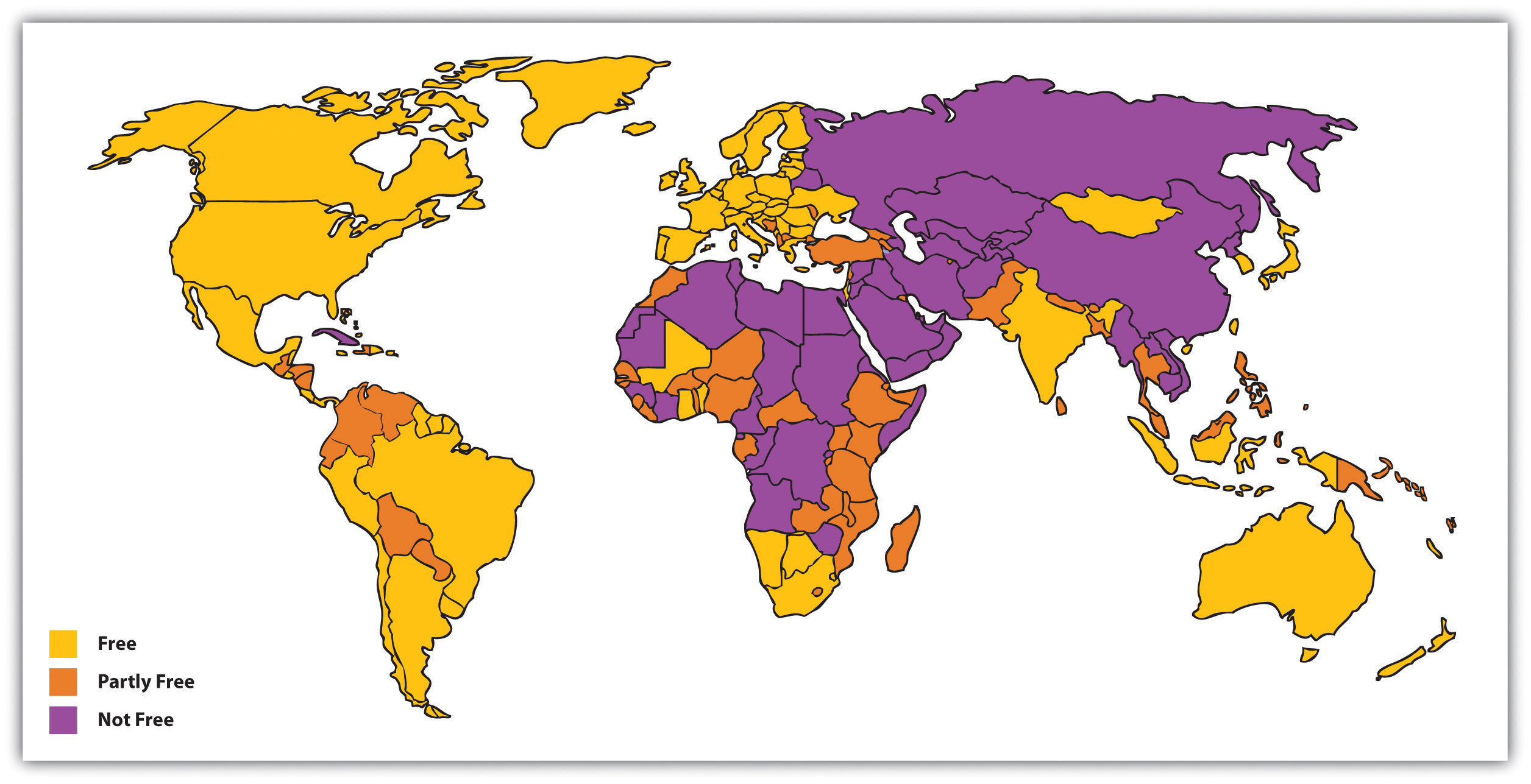
In improver to generally enjoying the correct to vote, people in democracies also accept more freedom than those in other types of governments. Figure 14.one "Freedom Around the World (Based on Extent of Political Rights and Civil Liberties)" depicts the nations of the globe according to the extent of their political rights and civil liberties. The freest nations are found in North America, Western Europe, and certain other parts of the earth, while the to the lowest degree free lie in Asia, the Middle Due east, and Africa.
Effigy xiv.one Freedom Around the World (Based on Extent of Political Rights and Civil Liberties)
Monarchy
Monarchy is a political system in which power resides in a single family that rules from ane generation to the next generation. The power the family unit enjoys is traditional dominance, and many monarchs command respect considering their subjects bestow this type of authorization on them. Other monarchs, still, accept ensured respect through arbitrary power and even terror. Royal families still rule today, only their power has declined from centuries ago. Today the Queen of England holds a largely ceremonial position, but her predecessors on the throne wielded much more power.
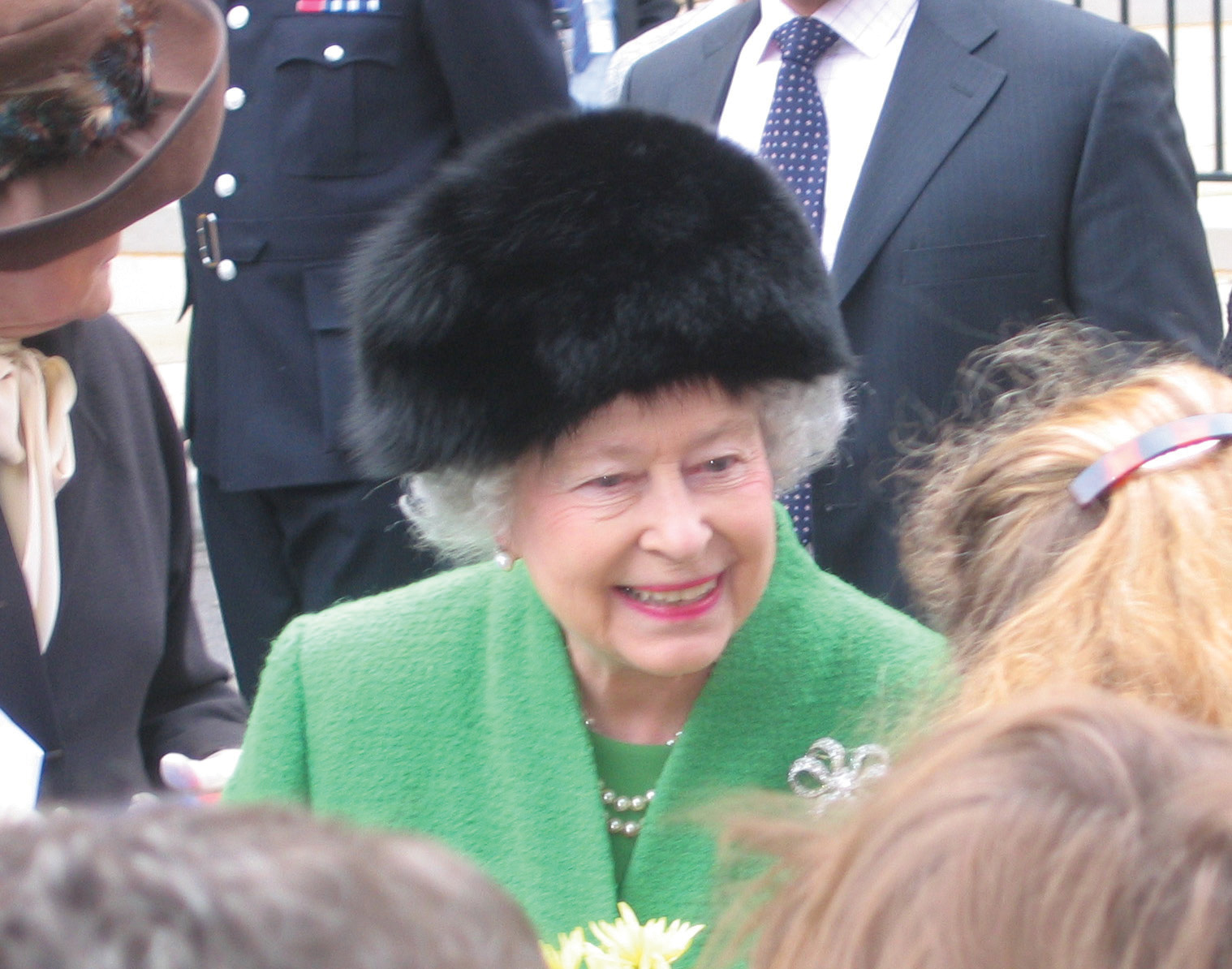
Queen Elizabeth Ii of England holds a largely ceremonial position, but earlier English monarchs held much more power.
This example reflects a historical change in types of monarchies from absolute monarchies to constitutional monarchies (Finer, 1997). In absolute monarchies, the regal family claims a divine right to rule and exercises considerable ability over their kingdom. Accented monarchies were common in both ancient (e.chiliad., Egypt) and medieval (eastward.yard., England and China) times. In reality, the power of many absolute monarchs was not totally absolute, as kings and queens had to keep in mind the needs and desires of other powerful parties, including the clergy and nobility. Over time, accented monarchies gave mode to ramble monarchies. In these monarchies, the royal family serves a symbolic and formalism role and enjoys piddling, if any, real power. Instead the executive and legislative branches of regime—the prime number minister and parliament in several nations—run the government, even if the royal family unit continues to command admiration and respect. Constitutional monarchies exist today in several nations, including Denmark, Peachy Britain, Norway, Spain, and Sweden.
Authoritarianism and Totalitarianism
Absolutism and totalitarianism are general terms for nondemocratic political systems ruled by an individual or a grouping of individuals who are not freely elected past their populations and who often practise arbitrary power. To exist more specific, absolutism refers to political systems in which an individual or a group of individuals holds ability, restricts or prohibits popular participation in governance, and represses dissent. Totalitarianism refers to political systems that include all the features of authoritarianism only are fifty-fifty more repressive every bit they try to regulate and command all aspects of citizens' lives and fortunes. People can be imprisoned for deviating from adequate practices or may even be killed if they dissent in the mildest of means. The purple nations in Figure 14.1 "Freedom Around the Earth (Based on Extent of Political Rights and Civil Liberties)" are mostly totalitarian regimes, and the orangish ones are authoritarian regimes.
Compared to democracies and monarchies, authoritarian and totalitarian governments are more unstable politically. The major reason for this is that these governments enjoy no legitimate say-so. Instead their power rests on fear and repression. The populations of these governments practice not willingly lend their obedience to their leaders and realize that their leaders are treating them very poorly; for both these reasons, they are more likely than populations in democratic states to want to rebel. Sometimes they do rebel, and if the rebellion becomes sufficiently massive and widespread, a revolution occurs. In contrast, populations in democratic states usually perceive that they are treated more or less adequately and, further, that they can change things they do non like through the balloter process. Seeing no need for revolution, they exercise not defection.
Since World War II, which helped make the United States an international power, the United States has opposed some authoritarian and totalitarian regimes while supporting others. The Cold War pitted the United States and its allies against Communist nations, primarily the Soviet Union, Red china, Cuba, and North Korea. But at the same time the United States opposed these authoritarian governments, it supported many others, including those in Republic of chile, Guatemala, and S Vietnam, that repressed and even murdered their own citizens who dared to engage in the kind of dissent constitutionally protected in the United States (Sullivan, 2008). Earlier in U.S. history, the federal and state governments repressed dissent past passing legislation that prohibited criticism of World War I and so by imprisoning citizens who criticized that war (Goldstein, 2001). During the 1960s and 1970s, the FBI, the CIA, and other federal agencies spied on tens of thousands of citizens who engaged in dissent protected by the First Subpoena (Cunningham, 2004). While the United States remains a buoy of freedom and hope to much of the world's peoples, its own back up for repression in the recent and more distant past suggests that eternal vigilance is needed to ensure that "liberty and justice for all" is non just an empty slogan.
Cardinal Takeaways
- The major types of political systems are democracies, monarchies, and authoritarian and totalitarian regimes.
- Authoritarian and totalitarian regimes are more unstable politically considering their leaders practice non enjoy legitimate authorisation and instead rule through fear.
For Your Review
- Why are democracies by and large more stable than authoritarian or totalitarian regimes?
- Why is legitimate authorization as Max Weber conceived it non a characteristic of authoritarian or totalitarian regimes?
References
Cunningham, D. (2004). There's something happening here: The new left, the Klan, and FBI counterintelligence. Berkeley: University of California Press.
Finer, South. Eastward. (1997). The history of government from the earliest times. New York, NY: Oxford Academy Press.
Goldstein, R. J. (2001). Political repression in modernistic America from 1870 to 1976 (Rev. ed.). Urbana: Academy of Illinois Press.
Seward, M. (2010). The representative merits. New York, NY: Oxford University Printing.
Sullivan, M. (2008). American adventurism away: Invasions, interventions, and regime changes since World War Two (Rev. and expanded ed.). Malden, MA: Blackwell.
Source: https://open.lib.umn.edu/sociology/chapter/14-2-types-of-political-systems/
0 Response to "Chapter 22 Section 1 Guided Reading and Review Historical Political Systems"
Post a Comment